10.06.2026
WeGenerate Publishes Second Policy Paper on Inclusive Energy Transitions
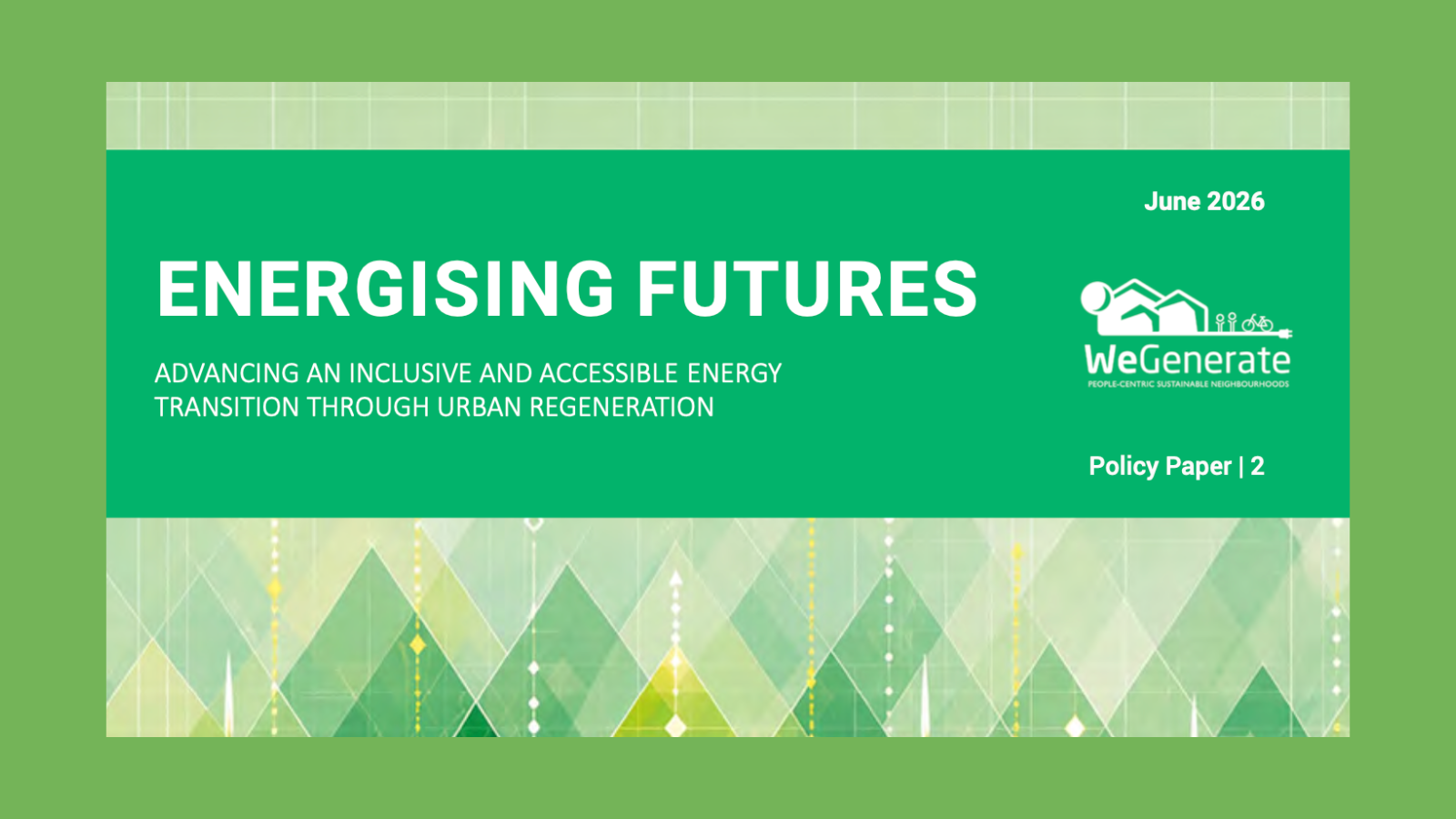
The WeGenerate project has released its second policy paper, Energising Futures: Advancing an Inclusive and Accessible Energy Transition through Urban Regeneration, examining how cities can ensure that the transition to sustainable energy systems is both socially inclusive and accessible to all.
As Europe accelerates efforts to decarbonise its energy systems, concerns about affordability, energy poverty, and unequal access to the benefits of the transition are becoming increasingly prominent. The new policy paper argues that a just energy transition cannot be achieved through technology deployment alone. Instead, it requires carefully designed pathways that combine social, technical, and institutional measures while actively engaging citizens and communities.
The publication analyses the current European policy landscape, highlighting how initiatives such as the Clean Energy for All Europeans Package, the Social Climate Fund, and legislation on renewable energy and energy efficiency have strengthened the social dimension of energy policy. However, it also identifies persistent challenges, including fragmented implementation, regulatory complexity, limited local capacity, and barriers to citizen participation.
A central contribution of the paper is the presentation of a practical framework that views the energy transition as a sequenced and interconnected process. Rather than treating policy instruments as isolated actions, the framework outlines five progressive steps that create the conditions for long-term success:
• Energy literacy and citizen awareness;
• Energy efficiency and building refurbishment;
• Renewable energy deployment;
• Renewable Energy Communities (RECs);
• Positive Energy Districts (PEDs).
According to the paper, each step builds on the previous one. Strengthening energy literacy helps citizens understand and engage with energy-related decisions, while energy-efficient buildings create the foundation for renewable energy systems. These, in turn, support the development of Renewable Energy Communities and, ultimately, Positive Energy Districts capable of delivering environmental, social, and economic benefits at neighbourhood scale.
The policy paper draws on experiences from WeGenerate Demo Cities and associated urban initiatives across Europe, including Bucharest (Romania), Cesena (Italy), Cascais (Portugal), Liepāja (Latvia), Barcelona (Spain), and Kadıköy (Türkiye). These examples demonstrate how cities are addressing energy vulnerability, improving building performance, supporting citizen participation, and exploring innovative models for local energy generation and sharing.
The findings underline the crucial role of cities as implementation brokers, translating European ambitions into practical actions that respond to local needs. From one-stop-shops supporting household renovations to collective self-consumption schemes and energy communities, local authorities are shown to be essential actors in ensuring that the energy transition delivers tangible benefits for citizens.
The publication concludes with a set of policy recommendations for European, national, and local decision-makers. These include strengthening social conditionality in energy legislation, investing in energy literacy and citizen support services, improving access to financing, enhancing energy poverty monitoring, and recognising Renewable Energy Communities as socio-technical systems that require both technical infrastructure and social engagement.
Ultimately, Energising Futures argues that an inclusive energy transition depends not only on accelerating decarbonisation but also on ensuring that citizens have the knowledge, opportunities, and support needed to participate in and benefit from the transformation of Europe’s energy systems.
Read the full policy paper and discover how cities can help build a more inclusive, resilient, and community-centred energy future.
SHARE THIS ARTICLE