22.04.2026
Students co-design future visions for Cesena
In recent months, the Cesena Local Circle has completed an engagement process involving students from schools in the Vigne–Railway area, coordinated by the Aidoru Association. The activities, which started in October 2025, involved a class from the “R. L. Montalcini” Primary School, a class from the “T. M. Plauto” Lower Secondary School, and a class of teenagers from the “Garibaldi-Da Vinci” Upper Secondary School.
The programme aimed to support the development of critical thinking about the urban landscape and its transformations, promote peer education within a participatory framework, and strengthen the empowerment of younger generations in shaping their local environment.
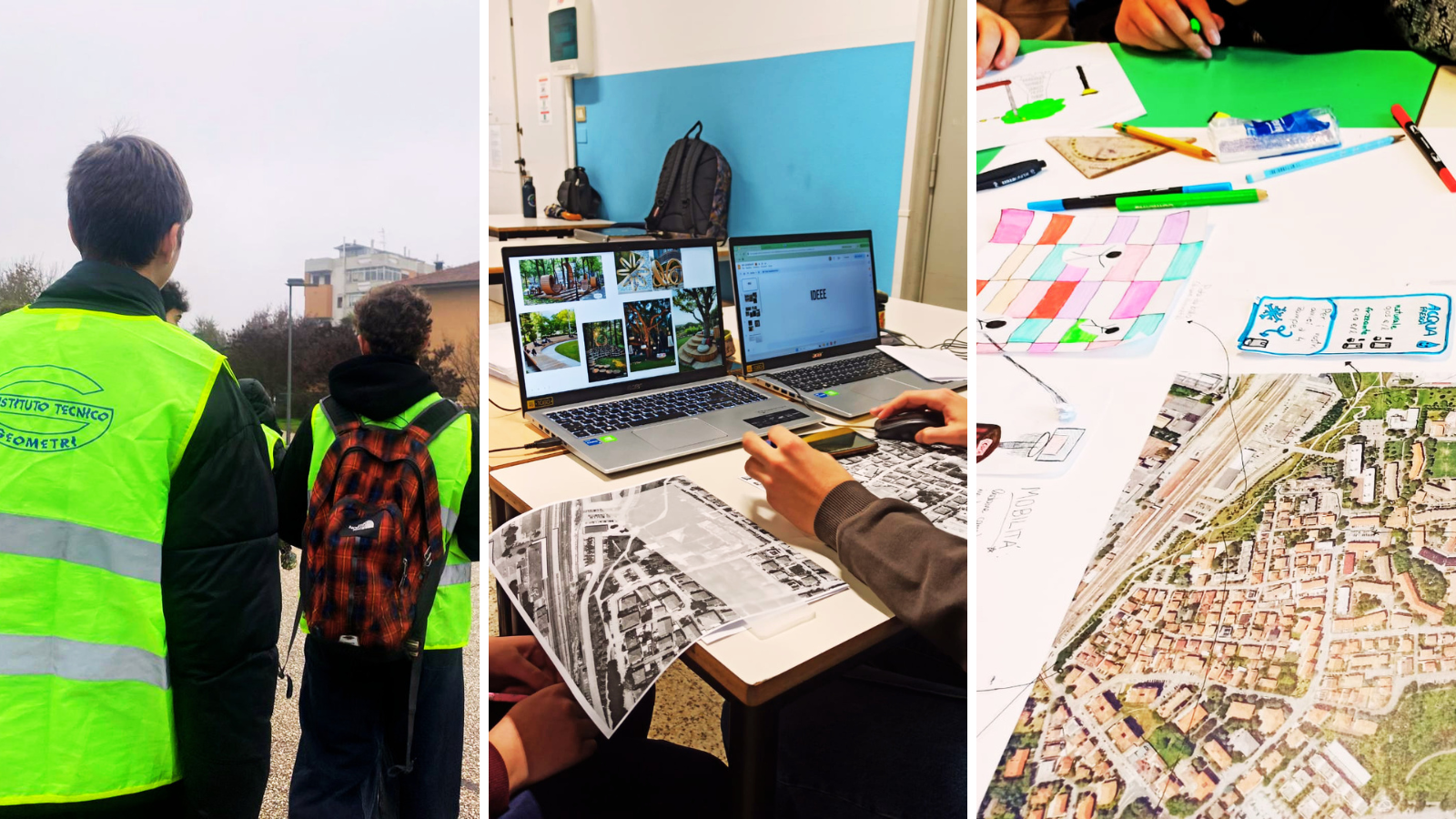
During the final phase (January–March 2026), six sessions were held with a third-year class from the “Garibaldi-Da Vinci” Technical Institute. The activities followed an integrated approach combining participatory facilitation, experiential learning and technical co-design practices, with the support of the institute’s teachers and researchers from the Department of Architecture at the University of Bologna.
The workshop with the teenagers focused on the linear park known as Parco Sopra Secante, located in the demo area on the north side of the railway line. The work built on ideas and proposals already developed for the area, including the results of co-design workshops with citizens, contributions from primary and lower secondary school students, outcomes of a workshop on temporary greening interventions by architecture students, and qualitative data collected through interviews with residents.
Students explored the site guided by three key questions: What do I see? What do I not see? What do I wish to see? Their observations highlighted a shared perception of a place with significant potential that nevertheless appears neglected and lacking in stories to tell: a beautiful park that few people truly experience.
Following this analysis, the students, working in groups, developed proposals using sketches, artificial intelligence tools, and design software (CAD and Revit).
The outcome was the development of a progressive and shared vision for the future of the area, well captured in a reflection from some of the students: “We realised that regenerating a space does not just mean repairing what is broken – it means imagining what it could become.”
Photos credits: Aidoru
SHARE THIS ARTICLE