04.05.2026
From Challenges to Change: European projects join forces to rethink energy supply
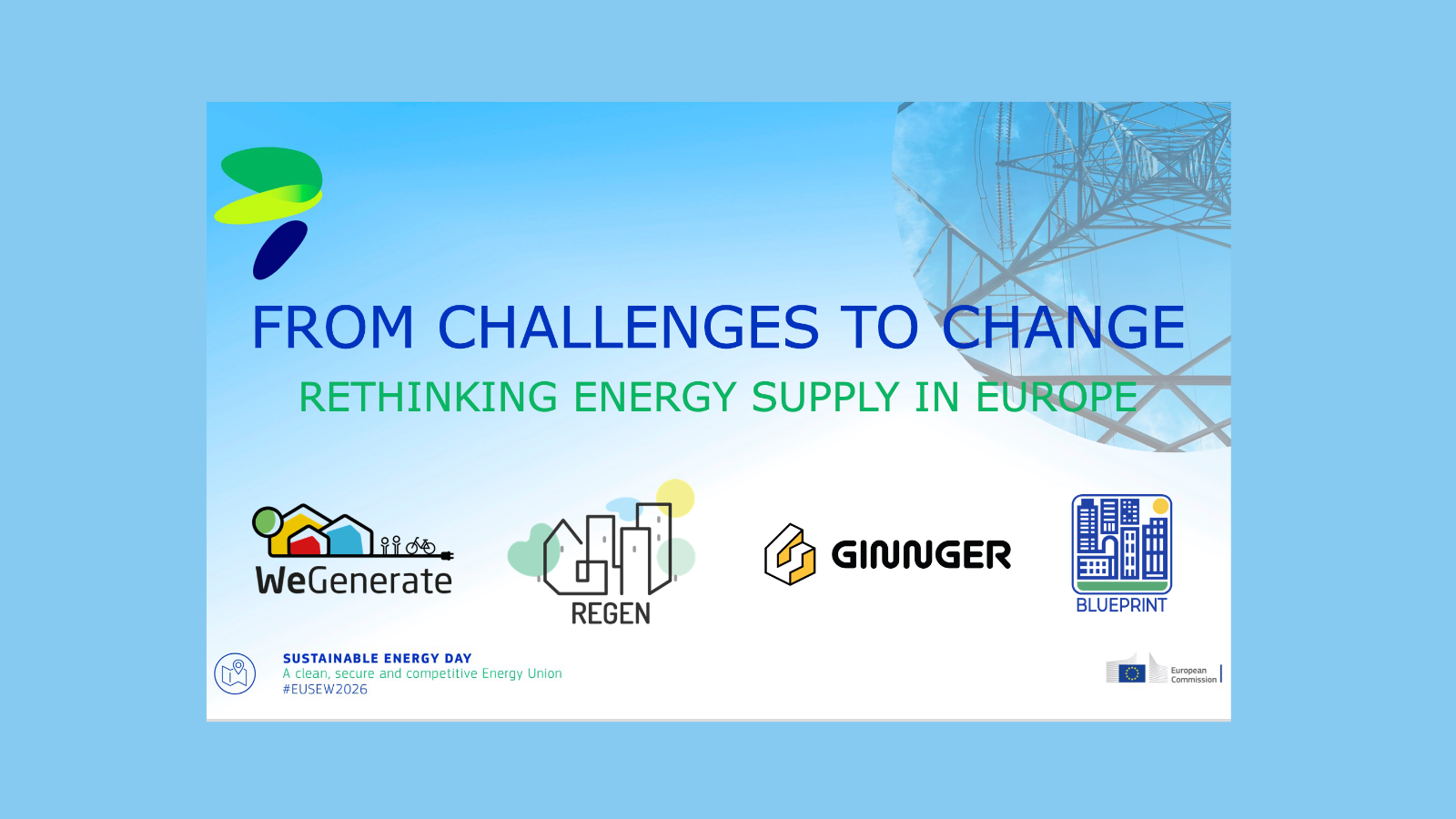
On 30 April 2026, the European Sustainable Energy Week 2026 hosted a timely online debate titled “From Challenges to Change: Rethinking Energy Supply in Europe.” The session was co-organised by the GINNGER Project, REGEN Project, BLUEPRINT Project, and WeGenerate Project, bringing together expertise from across Europe to address energy poverty and promote scalable, people-centred solutions.
The discussion focused on how cities and regions can accelerate the energy transition while ensuring inclusivity and long-term impact. Through concrete examples and practical insights, speakers highlighted how local initiatives can drive systemic change when supported by the right frameworks and collaborations.
The session featured contributions from:
- Cesar Valmaseda (CTIC Technology Centre)
- João Dinis (Cascais Ambiente – EMAC)
- Maëlle Haÿ (Municipality of Issy)
- Simone Nardicchia (Municipality of Milan)
The debate was moderated by Vicky Albert-Seifried (Fraunhofer-Institut für Solare Energiesysteme ISE), who guided the exchange towards actionable insights and cross-project synergies.
Key takeaways
The discussion reinforced several critical principles for advancing Europe’s energy transition:
Integrated, multi-sector approaches are essential
Energy challenges cannot be addressed in isolation. Effective solutions link infrastructure, buildings, and mobility, while also embedding climate adaptation and long-term community support.
Early and inclusive stakeholder engagement matters
Engaging stakeholders from the outset helps identify diverse needs, build shared values, and enable meaningful interdisciplinary collaboration.
Beyond technology: enabling lasting change
Energy transition is not purely technical. It requires capacity building, behavioural change, and sustained support to ensure long-term impact within communities.
Participation drives a just transition
Working closely with local communities—listening, co-creating solutions, and building trust—is fundamental to delivering outcomes that truly reflect local realities.
Multi-level governance is a key enabler
Strong coordination across municipal departments and alignment between local, regional, and national policies are necessary to scale solutions effectively.
Policy frameworks must support local action
Regional and national authorities play a crucial role by simplifying administrative processes, creating enabling conditions, and providing targeted incentives.
By bringing together four Horizon Europe projects, the session demonstrated the added value of collaboration in tackling shared challenges. For WeGenerate Project, the debate reaffirmed the importance of people-centred approaches in shaping sustainable neighbourhoods and ensuring that the energy transition delivers tangible benefits for communities.
As Europe continues to navigate the complexities of energy transformation, initiatives like this highlight the importance of collective action, knowledge exchange, and locally grounded innovation.
SHARE THIS ARTICLE